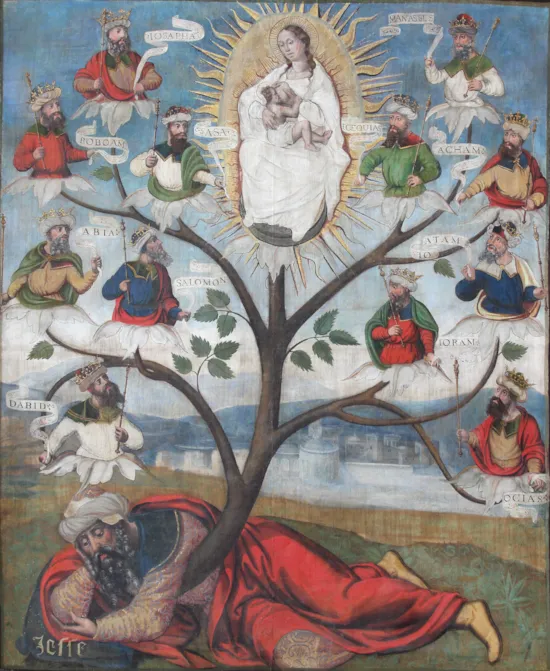
A Very Rare and Large Painting Depicting the ‘Tree of Jesse’
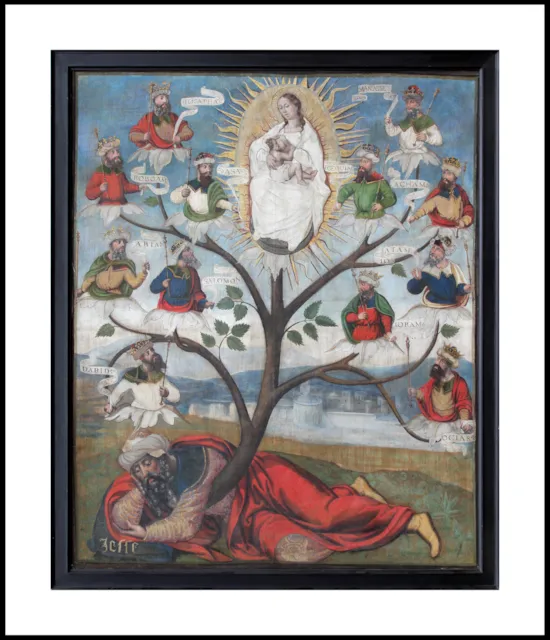
A Very Rare and Large Painting Depicting the ‘Tree of Jesse’
‘Sarga’ cloth and distemper, laid on canvas
Anonymous / Burgalese
Circa 1500 - 1510
Castilian School, Burgos, Spain
Size: 194cm high, 160cm wide - 76 ins high, 63 ins wide
Provenance:
Ex Private collection
‘Sarga’ cloth and distemper, laid on canvas
Anonymous / Burgalese
Circa 1500 - 1510
Castilian School, Burgos, Spain
Size: 194cm high, 160cm wide - 76 ins high, 63 ins wide
Provenance:
Ex Private collection
Circa 1500 - 1510
16th Century
Spain
‘Sarga’ cloth and distemper, laid on canvas
194 x 160 cm (76 ³/₈ x 63 inches)
16th Century
Spain
‘Sarga’ cloth and distemper, laid on canvas
194 x 160 cm (76 ³/₈ x 63 inches)
The ‘Tree of Jesse’ is an artistic representation of Jesus Christ’s ancestors, presented as a branching tree, originating from Jesse of Bethlehem, the father of King David. It pioneered the use of family trees as schematic representations of genealogies.
The ‘Tree of Jesse’ has its origins in a biblical passage in the Book of Isaiah, which metaphorically describes the Messiah’s descent. Christians interpret this passage as referring to Jesus. The figures depicted in Jesus’ lineage are drawn from the names listed in the Gospels of Matthew and Luke.
The subject of the Tree of Jesse is frequently depicted in Christian art, particularly during the medieval period. The earliest known example is an illuminated manuscript dating back to the 11th century. Medieval psalters are rich in examples of the ‘Tree of Jesse’ due to its connection to King David, son of Jesse, and the author of the Psalms. Further examples can be seen in stained glass windows, stone carvings around medieval cathedral portals, wall and ceiling paintings. The iconography continues to appear in other period art forms such as embroideries and ivory carvings.
During the 16th century, the Castilian School was profoundly influenced by Hispano-Flemish artistic traditions. This period witnessed the emergence of delicate ‘line-work’ and luminous colours, marking a transition towards the early Renaissance realism.
‘Sarga’ was a distinctive painting technique that utilised ‘sarga’ cloth, a coarse and inexpensive textile typically composed of linen or hemp. The pigments were applied directly to the cloth using ‘glue’ or distemper. These large paintings, often employed for devotional purposes, served as processional banners, ephemeral decorations, or wall hangings within churches and convents.
The fragility of the textile resulted in the relatively few surviving examples of this art form. Our particular painting is not only rare but also a remarkable survivor from the body of work produced during this period in and around Burgos.
The ‘Tree of Jesse’ has its origins in a biblical passage in the Book of Isaiah, which metaphorically describes the Messiah’s descent. Christians interpret this passage as referring to Jesus. The figures depicted in Jesus’ lineage are drawn from the names listed in the Gospels of Matthew and Luke.
The subject of the Tree of Jesse is frequently depicted in Christian art, particularly during the medieval period. The earliest known example is an illuminated manuscript dating back to the 11th century. Medieval psalters are rich in examples of the ‘Tree of Jesse’ due to its connection to King David, son of Jesse, and the author of the Psalms. Further examples can be seen in stained glass windows, stone carvings around medieval cathedral portals, wall and ceiling paintings. The iconography continues to appear in other period art forms such as embroideries and ivory carvings.
During the 16th century, the Castilian School was profoundly influenced by Hispano-Flemish artistic traditions. This period witnessed the emergence of delicate ‘line-work’ and luminous colours, marking a transition towards the early Renaissance realism.
‘Sarga’ was a distinctive painting technique that utilised ‘sarga’ cloth, a coarse and inexpensive textile typically composed of linen or hemp. The pigments were applied directly to the cloth using ‘glue’ or distemper. These large paintings, often employed for devotional purposes, served as processional banners, ephemeral decorations, or wall hangings within churches and convents.
The fragility of the textile resulted in the relatively few surviving examples of this art form. Our particular painting is not only rare but also a remarkable survivor from the body of work produced during this period in and around Burgos.
Ex Private collection
A Very Rare and Large Painting Depicting the ‘Tree of Jesse’