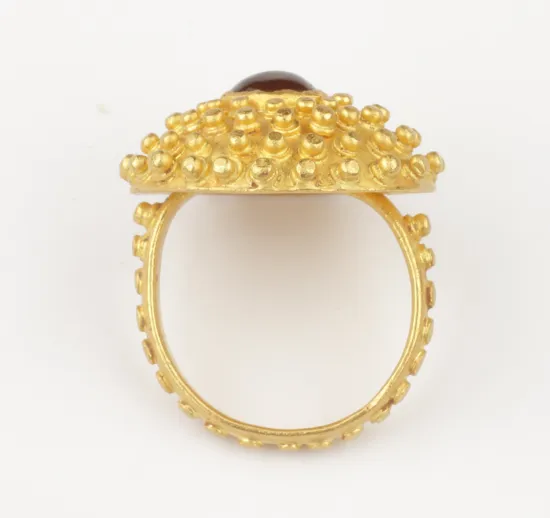
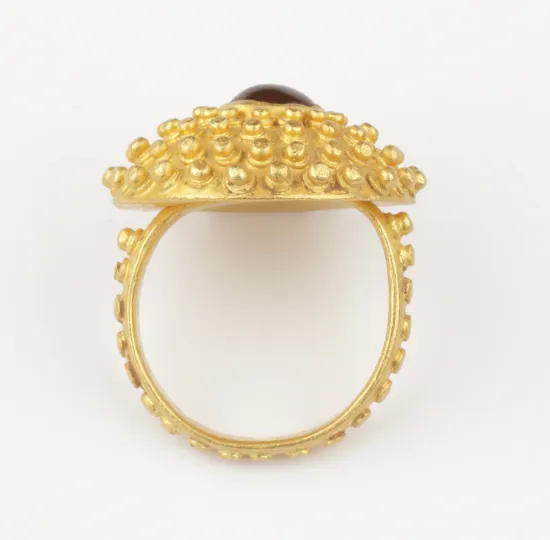
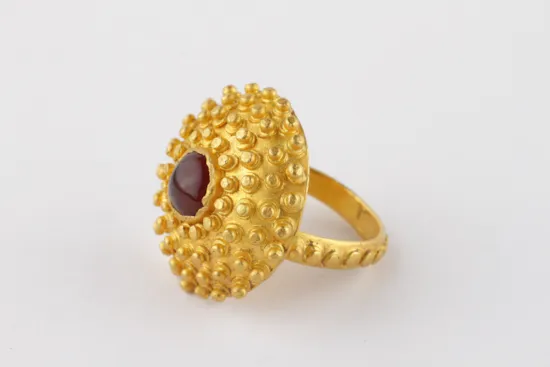
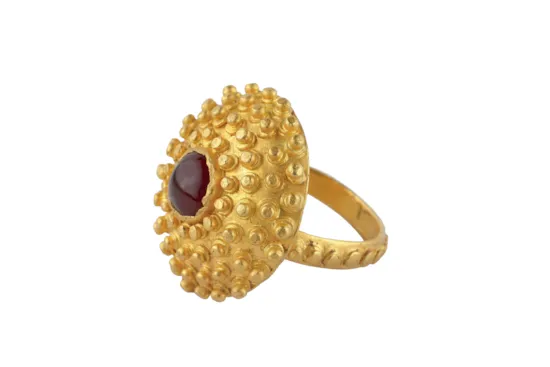
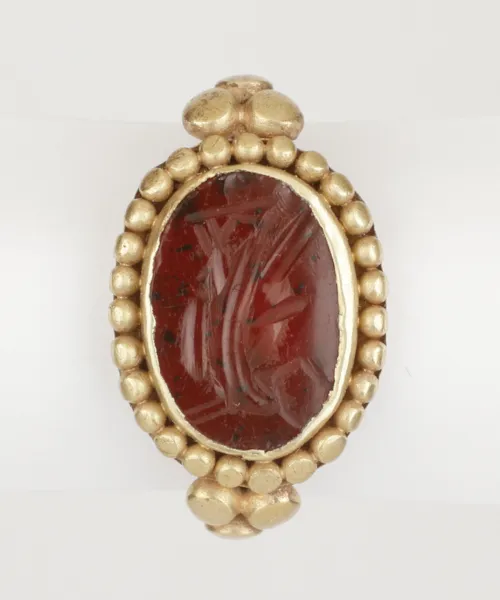
A Migration Period or Early Medieval Slavic Finger-Ring with Hemispherical Bezel
A Migration Period or Early Medieval Slavic Finger-Ring with Hemispherical
Bezel Decorated with Collared Granules and Garnet Cabochon
Gold, garnet
Migration Period / possibly Moravia (modern Eastern Czech Republic)
9th Century
Size: 59 (EU) R (UK) 8 5/8 (US)
Weight: 14.9 grams
Provenance: Formerly Hanns-Ulrich Haedeke collection, former Director, German Sword Museum, Solingen, and author of Schmuck aus drei Jahrtausenden: Sammlung Hanns-Ulrich Haedeke (Köln: Rheinland Verlag, 2000)
Ex Private collection
Bezel Decorated with Collared Granules and Garnet Cabochon
Gold, garnet
Migration Period / possibly Moravia (modern Eastern Czech Republic)
9th Century
Size: 59 (EU) R (UK) 8 5/8 (US)
Weight: 14.9 grams
Provenance: Formerly Hanns-Ulrich Haedeke collection, former Director, German Sword Museum, Solingen, and author of Schmuck aus drei Jahrtausenden: Sammlung Hanns-Ulrich Haedeke (Köln: Rheinland Verlag, 2000)
Ex Private collection
A Migration Period or Early Medieval Slavic Finger-Ring with Hemispherical
Bezel Decorated with Collared Granules and Garnet Cabochon
Gold, garnet
Migration Period / possibly Moravia (modern Eastern Czech Republic)
9th Century
Size: 59 (EU) R (UK) 8 5/8 (US)
Weight: 14.9 grams
Bezel Decorated with Collared Granules and Garnet Cabochon
Gold, garnet
Migration Period / possibly Moravia (modern Eastern Czech Republic)
9th Century
Size: 59 (EU) R (UK) 8 5/8 (US)
Weight: 14.9 grams
Numerous gold and silver finger rings with large hemispherical bezels, adorned with collared granules, have been discovered in 9th Century Slavic burials in Moravia, which is part of the Great Moravian archaeological horizon. The material culture reflects the unification of Slavic tribes following the decline of Avar power in the late 8th century under Frankish influence. Examples are found in Rajhrad, Staré Město, Mikulčice, and Předmostí. Great Moravian rings exhibit distinct Frankish influence, such as triple granules at the shoulders and carpet-style filigree bands. The present ring, lacking these features, likely predates Frankish dominance and belongs to an earlier Slavic phase. Rings with hemispherical, granule-decorated bezels are believed to have originated from earlier Slavic interactions with the Eastern Roman Empire, where some Slavs served as Foederati. Similar ‘shield boss’ motifs are present in the work of Late Roman goldsmiths, often associated with military items, such as a Germanic fibula in the Römisch-Germanisches Museum (inv. D 9). The applied granules resemble the studded ‘umbo’ of shields used as striking weapons. A closely related ring, previously housed in the J. Bagot collection (El Legado de Hefesto, no. 365), set with a Late Roman carnelian military intaglio, may have belonged to a Slavic Foederatus. Both rings demonstrate the evolution of Great Moravian jewellery from Late Roman and Migration-period prototypes.
Formerly Hanns-Ulrich Haedeke collection, former Director, German Sword Museum, Solingen, and author of Schmuck aus drei Jahrtausenden: Sammlung Hanns-Ulrich Haedeke (Köln: Rheinland Verlag, 2000)
Ex Private collection
Ex Private collection
A Migration Period or Early Medieval Slavic Finger-Ring with Hemispherical Bezel