A Merovingian Frankish Gold Finger-Ring with a Re-used Late Imperial Carnelian Intaglio
A Merovingian Frankish Gold Finger-Ring with a Re-used Late Imperial
Carnelian Intaglio
Gold, carnelian
Probably Neustria / Western Frankish Kingdom (including the Paris region)
Last quarter of the 6th Century
The intaglio: Western Empire, probably Gaul, circa 3rd century AD
Size: 51 (EU) K 1/2 (UK) 5 3/8 (US)
Weight: 4.9 grams
Carnelian Intaglio
Gold, carnelian
Probably Neustria / Western Frankish Kingdom (including the Paris region)
Last quarter of the 6th Century
The intaglio: Western Empire, probably Gaul, circa 3rd century AD
Size: 51 (EU) K 1/2 (UK) 5 3/8 (US)
Weight: 4.9 grams
A Merovingian Frankish Gold Finger-Ring with a Re-used Late Imperial
Carnelian Intaglio
Gold, carnelian
Probably Neustria / Western Frankish Kingdom (including the Paris region)
Last quarter of the 6th Century
The intaglio: Western Empire, probably Gaul, circa 3rd century AD
Carnelian Intaglio
Gold, carnelian
Probably Neustria / Western Frankish Kingdom (including the Paris region)
Last quarter of the 6th Century
The intaglio: Western Empire, probably Gaul, circa 3rd century AD
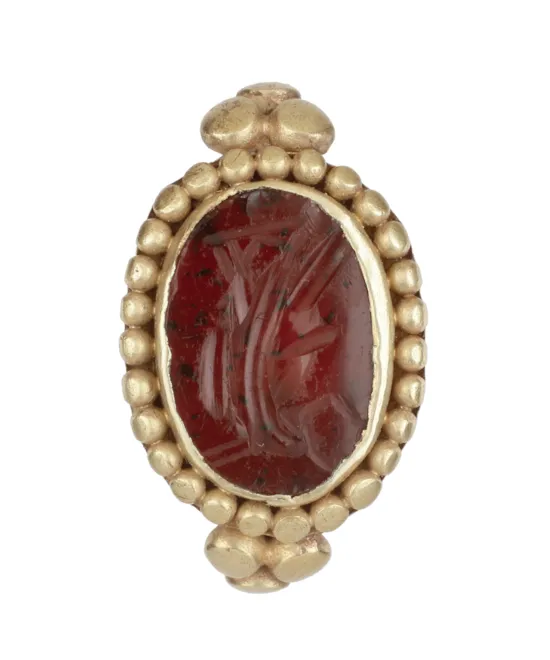
The ring belongs to the earliest series of the most distinctive Merovingian prestige finger rings, those with circular or oval bezels supported by three globules at each shoulder where the bezel meets the band. Rings from this group, dating before 600 AD, include the renowned gold name ring from tomb 49 beneath the Basilica of Saint-Denis, recently reattributed to Queen Arégonde (d. 580 AD), wife of Clotaire I and mother of Chilperic I. The Arégonde ring and related examples are characterised by large shoulder globules and bezels edged with individually applied granules rather than beaded wire. Another ring of this series, found at Chelles near Paris (Musée Archéologique National) and bearing an early image of Christ, shares with the present piece a rounded ribbon-shaped band that joins the bezel with trapezoidal terminals. Unlike those with solid engraved bezels, this ring features a rub-over setting enclosing a Late Roman carnelian intaglio showing an eagle carrying a wreath. The gem, likely once mounted in a Roman legionary’s ring, exemplifies the reuse of Roman ‘spolia’ typical of Merovingian art. Rings incorporating re-used Roman stones are numerous, notably the celebrated example from the early Anglo-Saxon Snape ship burial in the British Museum.
Ex Private US collection
Ex Private collection
Ex Private collection
A Merovingian Frankish Gold Finger-Ring with a Re-used Late Imperial Carnelian Intaglio