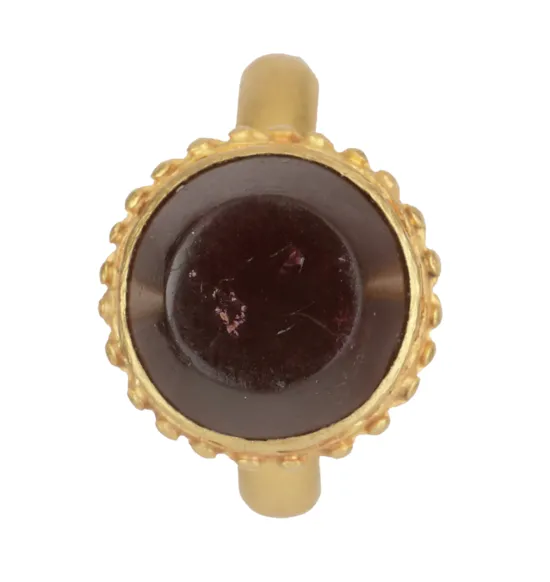
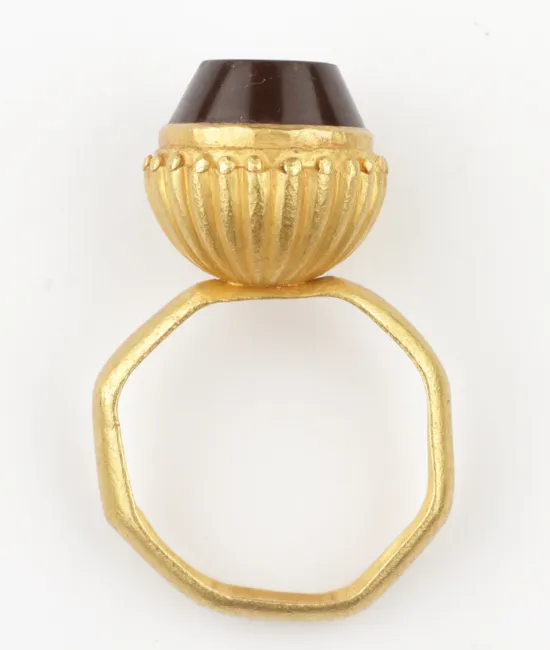
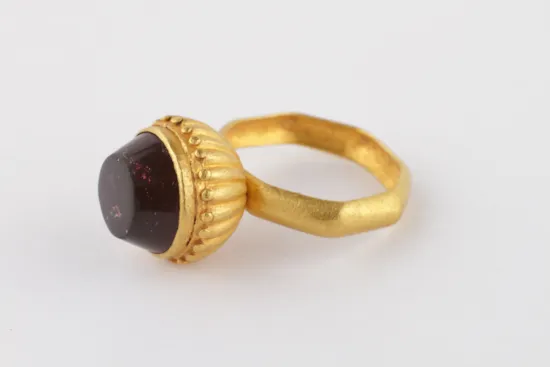
An Early and Rare Byzantine Finger-Ring with High Calyx-Shaped Bezel set with Flat-Topped Conical Garnet
An Early and Rare Byzantine Finger-Ring with High Calyx-Shaped Bezel set with Flat-Topped Conical Garnet
Gold, garnet
Constantinople
Late 5th Century
Size: 64 (EU) V 1/2 (UK) 10 1/2 (US)
Weight: 12.8 grams
Provenance: Formerly Hanns-Ulrich Haedeke collection, former Director, German Sword Museum, Solingen, and author of Schmuck aus drei Jahrtausenden: Sammlung Hanns-Ulrich Haedeke (Köln: Rheinland Verlag, 2000)
Ex Private collection
Gold, garnet
Constantinople
Late 5th Century
Size: 64 (EU) V 1/2 (UK) 10 1/2 (US)
Weight: 12.8 grams
Provenance: Formerly Hanns-Ulrich Haedeke collection, former Director, German Sword Museum, Solingen, and author of Schmuck aus drei Jahrtausenden: Sammlung Hanns-Ulrich Haedeke (Köln: Rheinland Verlag, 2000)
Ex Private collection
An Early and Rare Byzantine Finger-Ring with High Calyx-Shaped Bezel set with Flat-Topped Conical Garnet
Gold, garnet
Constantinople
Late 5th Century
Size: 64 (EU) V 1/2 (UK) 10 1/2 (US)
Weight: 12.8 grams
Gold, garnet
Constantinople
Late 5th Century
Size: 64 (EU) V 1/2 (UK) 10 1/2 (US)
Weight: 12.8 grams
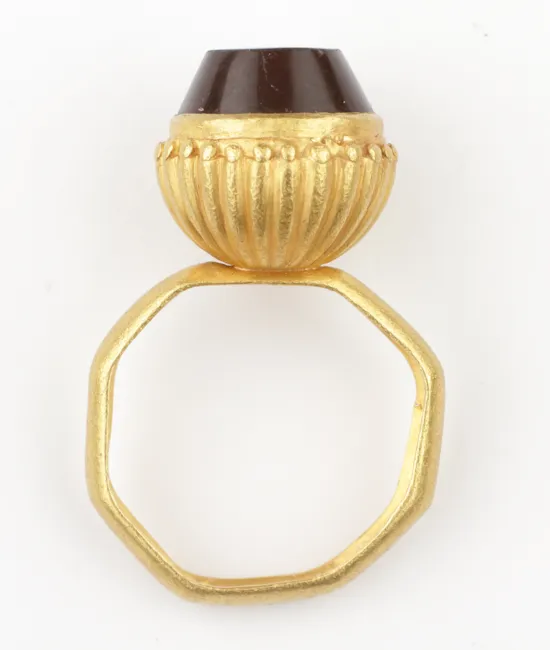
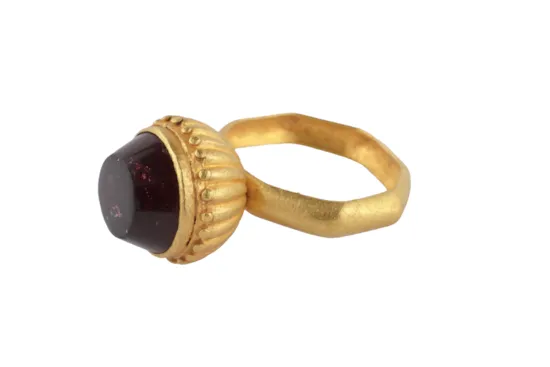
This imposing gold ring epitomises the opulence and authority of the Early Byzantine court. Rings characterised by their tall, ribbed, calyx-shaped bezels, occasionally adorned with garnets or repurposed Roman gems, originated from the imperial workshops of Constantinople. Securable dated examples from late 5th-century contexts attest to their presence. The most well-documented instances are two rings discovered in the 1957 Reggio Emilia hoard, which contained Byzantine and Germanic artefacts likely belonging to a Gothic leader under Emperor Zeno (474 - 491). Coincidentally found with a gold cruciform fibula similar to that found in King Childeric’s grave at Tournai, these rings symbolise imperial gifts bestowed upon esteemed allies. A comparable example was unearthed in a late 5th century hoard at Istria, Romania, potentially deposited by Goths. Additional instances are housed in the Musée de Cluny, the Musée d’Archéologie Nationale, and the former Edouard Guilhou collection. The Reggio Emilia rings share with the present piece their octagonal bands, while the Istria ring’s flat-topped conical garnet closely resembles that of the present example. Garnets of this type, occasionally engraved, adorn other elite Constantinopolitan rings, including one depicting Emperor Theodosius II (401 - 450). These high-bezel Byzantine rings maintained a strong association of imperial splendour among early medieval Germanic elites, inspiring subsequent imitations such as the ring of Queen Wisigard (510 - 538/40).
Formerly Hanns-Ulrich Haedeke collection, former Director, German Sword Museum, Solingen, and author of Schmuck aus drei Jahrtausenden: Sammlung Hanns-Ulrich Haedeke (Köln: Rheinland Verlag, 2000)
Ex Private collection
Ex Private collection
An Early and Rare Byzantine Finger-Ring with High Calyx-Shaped Bezel set with Flat-Topped Conical Garnet

YOU MAY ALSO LIKE