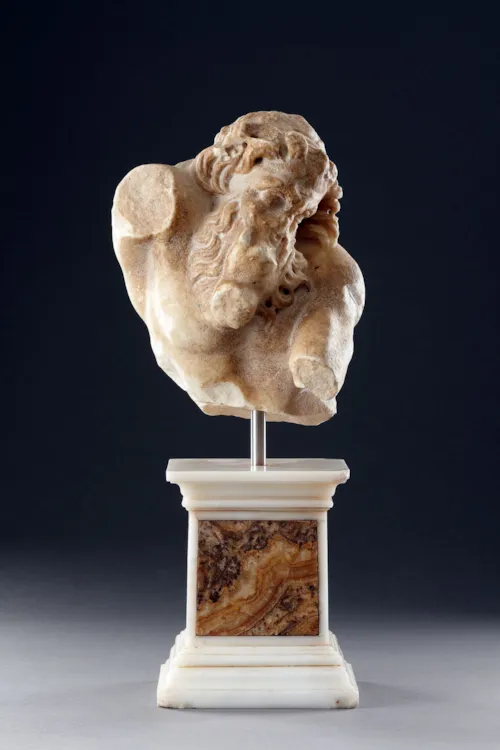
A Finely Cast Corpus from an Altar or Processional Cross
A Finely Cast Corpus from an Altar or Processional Cross
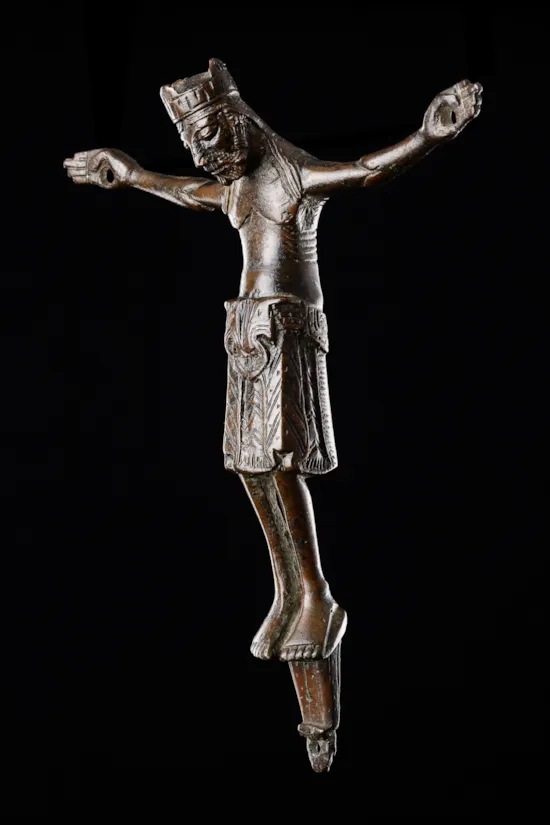
The crowned head slightly downcast with long flowing hair to Christ’s back and over his shoulders
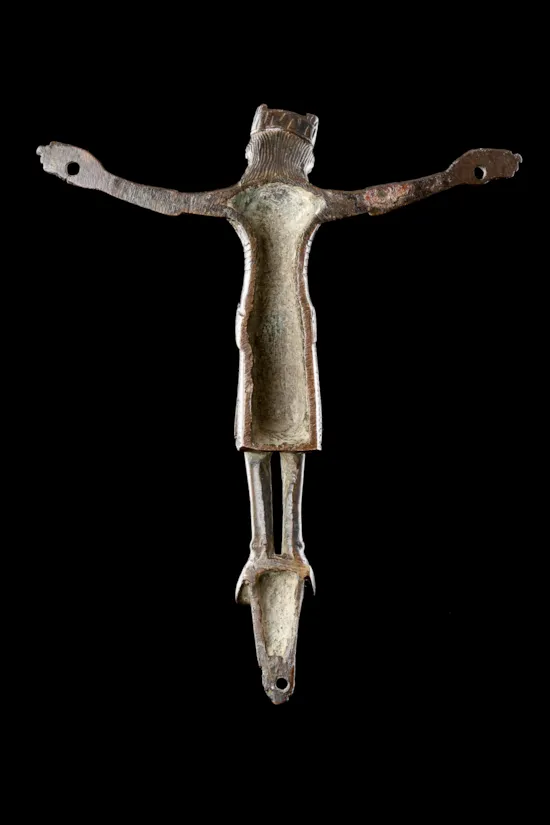
Pierced for attaching and hollow to the back
Bronze
Eastern France
12th Century
Size: 19cm high, 15cm wide - 7½ ins high, 6 ins wide A Finely Cast Corpus from an Altar or Processional Cross
The crowned head slightly downcast with long flowing hair to Christ’s back and over his shoulders
Pierced for attaching and hollow to the back
Bronze
Eastern France
12th Century
Size: 19cm high, 15cm wide - 7½ ins high, 6 ins wide
The crowned head slightly downcast with long flowing hair to Christ’s back and over his shoulders
Pierced for attaching and hollow to the back
Bronze
Eastern France
12th Century
Size: 19cm high, 15cm wide - 7½ ins high, 6 ins wide A Finely Cast Corpus from an Altar or Processional Cross
The crowned head slightly downcast with long flowing hair to Christ’s back and over his shoulders
Pierced for attaching and hollow to the back
Bronze
Eastern France
12th Century
Size: 19cm high, 15cm wide - 7½ ins high, 6 ins wide
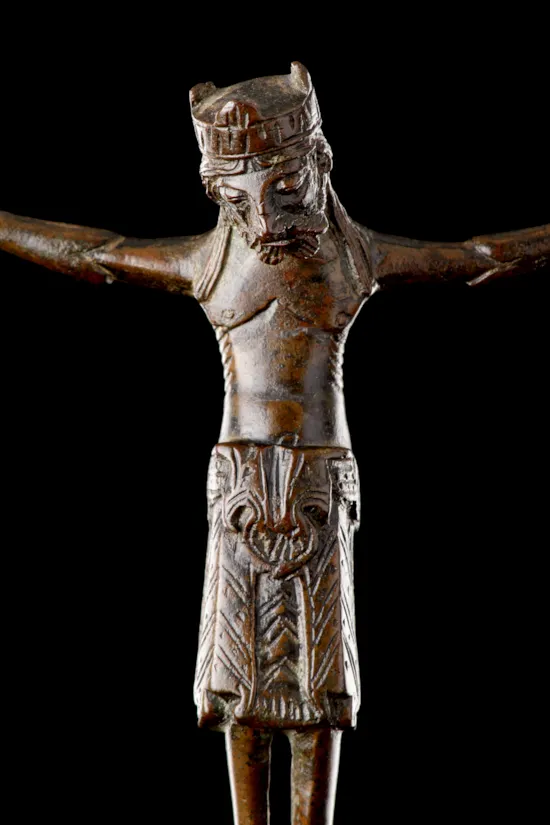
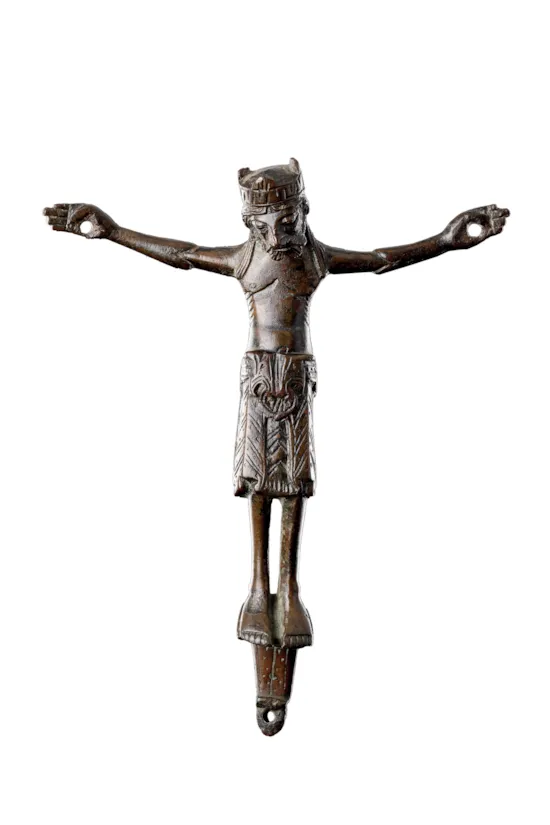
The Romanesque copper-alloy corpus of the crucified Christ, likely originating from Eastern France during the second half of the 12th century, is depicted being from either an altar or processional cross. This highly stylised corpus belongs to a recognisable group documented by Peter Bloch in his comprehensive study, Romanische Bronzekruzifixe, as ‘V D’. Bloch identifies the type in Eastern France, primarily based on an example preserved at the Besançon Musée des Beaux-Arts et d’Archéologie (V D 7). A second, related corpus is housed in the collection of the Detroit Institute of Arts (V D 8). Both corpora are supported by a wedge-shaped suppedaneum with legs parallel and knees slightly bent.
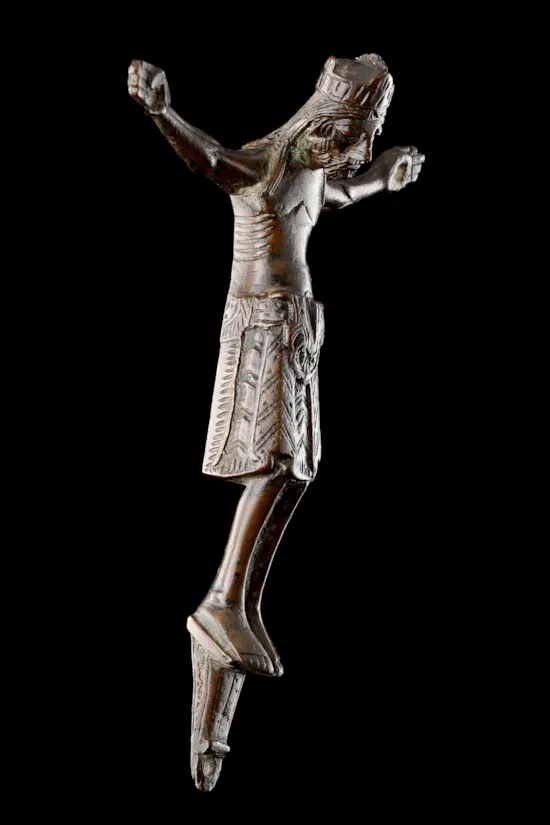
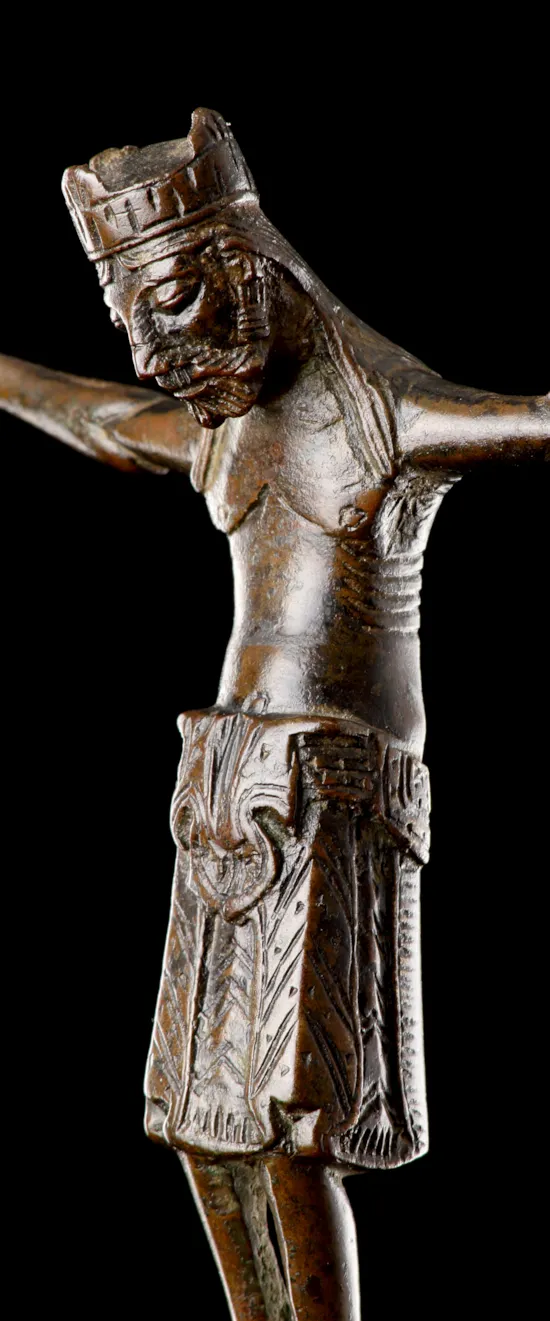
The perizonium, initially appearing as a chaotic pattern, is meticulously organised in the highly graphic yet ultimately logical and naturalistic manner characteristic of northern Romanesque figurative art. The loincloth is symmetrically draped over a wide cincgulum, with the excess fabric elegantly structured in the form of trapezoidal lappets at the hips and a central half-round pendant fold. Two substantial, tubular pleats descend from the waist to the knees, each terminating in a hollow, tau-shaped opening. The flat surfaces of the perizonium are meticulously worked with chiselled lines to create nested, V-shaped pleats.
The torso is emaciated, suggesting a state of decay, characterised by prominent ribs, a distended abdomen, and skin tightly stretched over the sternum. The head is positioned to the right, with the eyes closed, indicating Christ at or near death. The centrally parted hair is intricately corded and lies loosely in twin strands on the shoulders, while the beard is plaited in the customary Romanesque style. A king’s crown reflects the fusion of the triumphant and deceased Christ archetypes prevalent during the second half of the 12th century.
The perizonium, initially appearing as a chaotic pattern, is meticulously organised in the highly graphic yet ultimately logical and naturalistic manner characteristic of northern Romanesque figurative art. The loincloth is symmetrically draped over a wide cincgulum, with the excess fabric elegantly structured in the form of trapezoidal lappets at the hips and a central half-round pendant fold. Two substantial, tubular pleats descend from the waist to the knees, each terminating in a hollow, tau-shaped opening. The flat surfaces of the perizonium are meticulously worked with chiselled lines to create nested, V-shaped pleats.
The torso is emaciated, suggesting a state of decay, characterised by prominent ribs, a distended abdomen, and skin tightly stretched over the sternum. The head is positioned to the right, with the eyes closed, indicating Christ at or near death. The centrally parted hair is intricately corded and lies loosely in twin strands on the shoulders, while the beard is plaited in the customary Romanesque style. A king’s crown reflects the fusion of the triumphant and deceased Christ archetypes prevalent during the second half of the 12th century.
Ex Private European collection
A Finely Cast Corpus from an Altar or Processional Cross