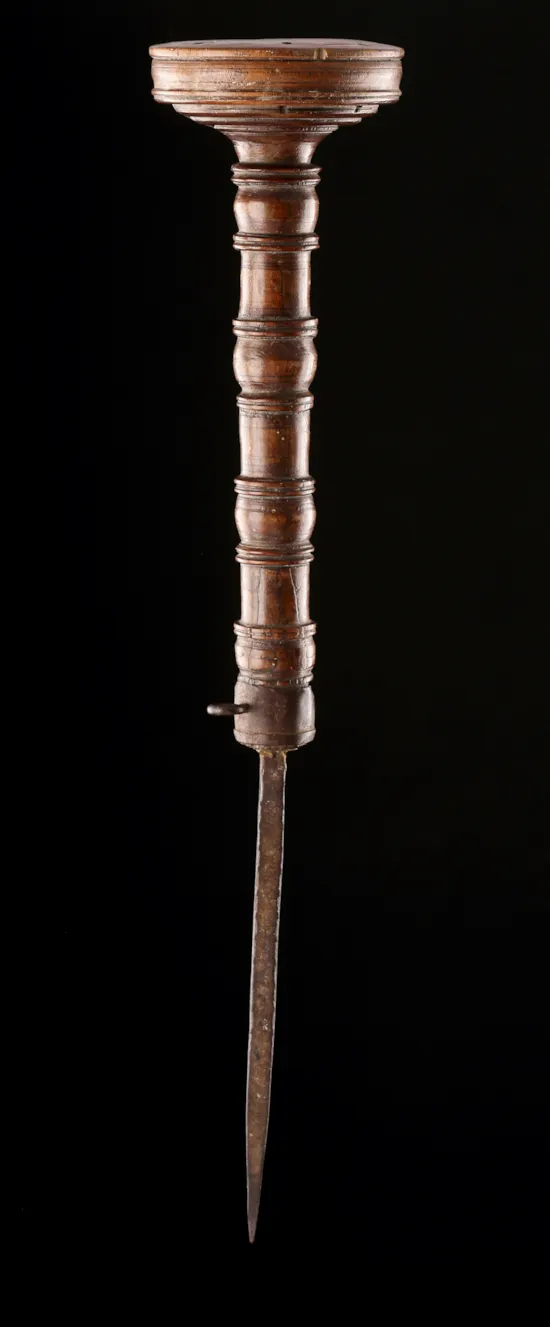
A Very Rare Renaissance Falconer's Bird Perch
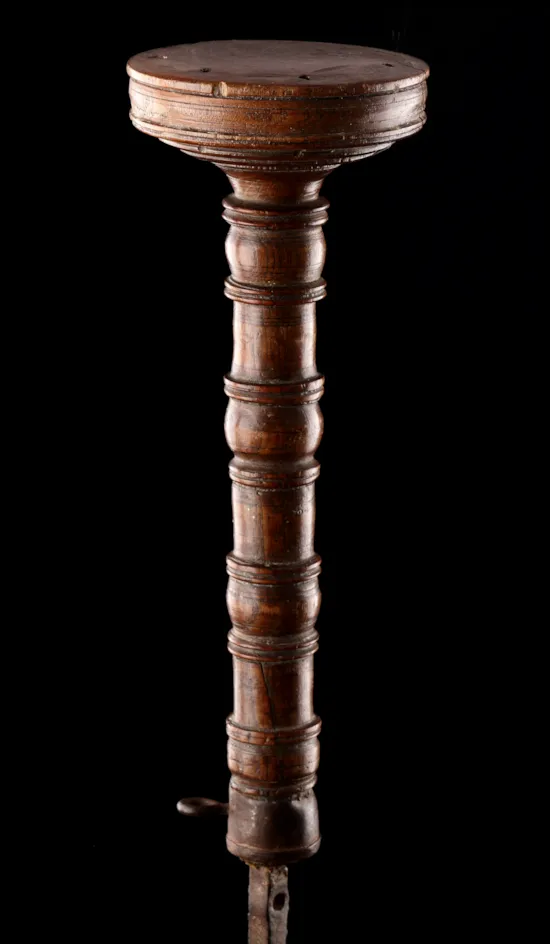
A Very Rare Late Renaissance Falconers Bird Perch
Turned Wood, Steel, Iron
Netherlandish / Low Countries
17th Century
Size: 60cm high, 23½ ins high
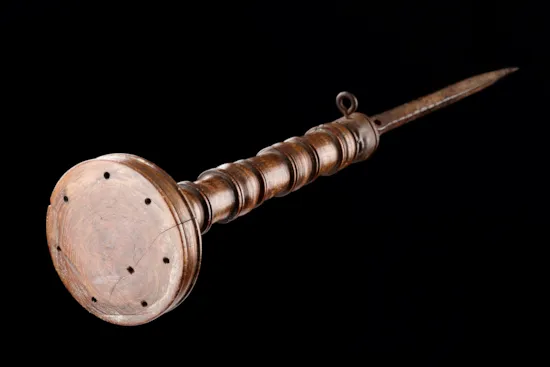
note: The simply, yet elegant turned support can easily be insetrted into the ground, for teh birds to rest upon, a leather pad, now missing / absent, would have been attached to the upper round cap, in order for the falconer's birds to rest before / between and after the 'hunt'.
Turned Wood, Steel, Iron
Netherlandish / Low Countries
17th Century
Size: 60cm high, 23½ ins high
note: The simply, yet elegant turned support can easily be insetrted into the ground, for teh birds to rest upon, a leather pad, now missing / absent, would have been attached to the upper round cap, in order for the falconer's birds to rest before / between and after the 'hunt'.
A Very Rare Late Renaissance Falconers Bird Perch
Turned Wood, Steel, Iron
Netherlandish / Low Countries
17th Century
Turned Wood, Steel, Iron
Netherlandish / Low Countries
17th Century
Originating around 1000 BC in the Asian steppes, falconry rose to become the favourite sport of European nobility and royalty during the Tudor age. With Henry VIII it was an obsession. He hawked both morning and afternoon if the weather was fine, and built a royal ‘mews’ at Charing Cross to house his precious birds. ‘Mews’ were originally built in London to house birds of prey while they moulted in the summer months. Shakespeare used many obscure falconry terms in his play ‘Taming of the Shrew’ and numerous terms have entered the English language and are still in general use: ‘fed up’, ‘haggard’, ‘hoodwinked’ and ‘cadge’.
Birds were trained to return to the call or whistle which were frequently made of wood or bone, but rarely of precious metal like this example. The peregrine is the noblest and most challenging of falcons to train and will take grouse by climbing dot high above heather moorland before folding its wings in a mesmerising 1000 foot towering, magnificent stoop.
No other form of hunting has been held in such high regard over the centuries as falconry and to have a noble falcon perched on the fist became a symbol of persons of rank. In the Middle East falcons are regarded as the quintessence of beauty, speed and audacity, and are still thought to be symbols of great status.
Birds were trained to return to the call or whistle which were frequently made of wood or bone, but rarely of precious metal like this example. The peregrine is the noblest and most challenging of falcons to train and will take grouse by climbing dot high above heather moorland before folding its wings in a mesmerising 1000 foot towering, magnificent stoop.
No other form of hunting has been held in such high regard over the centuries as falconry and to have a noble falcon perched on the fist became a symbol of persons of rank. In the Middle East falcons are regarded as the quintessence of beauty, speed and audacity, and are still thought to be symbols of great status.
Ex Private Dutch collection
A Very Rare Renaissance Falconer's Bird Perch