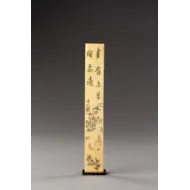
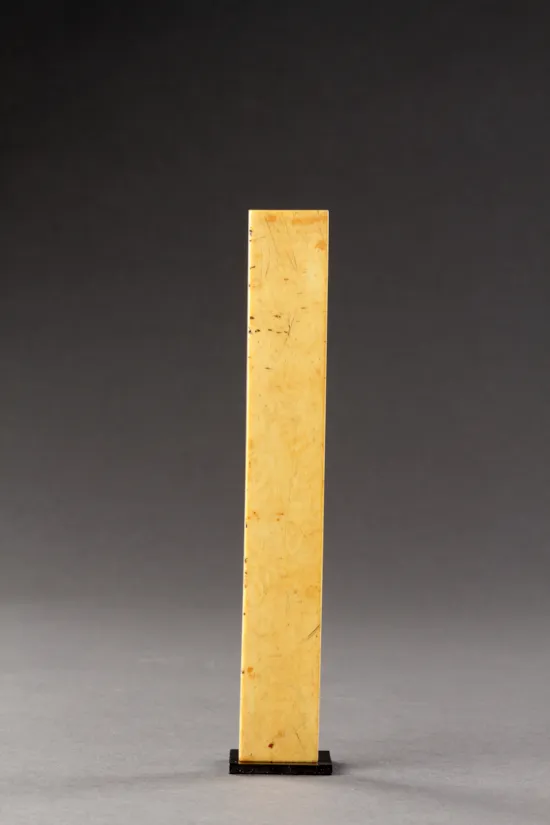
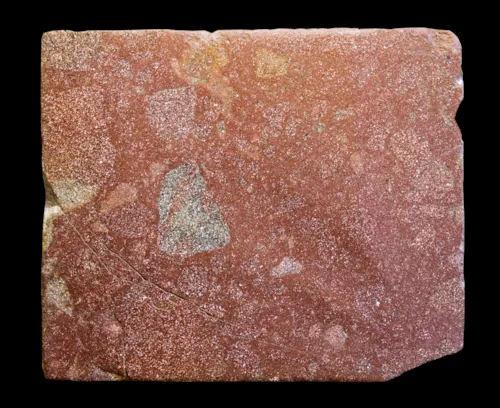
A Fine Scholars Scroll Weight
A Fine Scholars Scroll Weight
Carved landscape with figures to one side and calligraphy
Superb colour and patina
China
17th Century - Ming Dynasty
Size: 18cm long - 7 ins long
Belgium CITES: 2025/BE01682/CE
Carved landscape with figures to one side and calligraphy
Superb colour and patina
China
17th Century - Ming Dynasty
Size: 18cm long - 7 ins long
Belgium CITES: 2025/BE01682/CE
A Fine Scholars Scroll Weight
Carved landscape with figures to one side and calligraphy
Superb colour and patina
China
17th Century - Ming Dynasty
Size: 18cm long - 7 ins long
Belgium CITES: 2025/BE01682/CE
Carved landscape with figures to one side and calligraphy
Superb colour and patina
China
17th Century - Ming Dynasty
Size: 18cm long - 7 ins long
Belgium CITES: 2025/BE01682/CE
Perhaps the simplest of objects in the Chinese scholars studio is the scroll or paperweight. Its function was to keep the paper from curling up or moving whilst the calligrapher or artist was working. A scroll opened for viewing also had a tendency to close up again if the ends were not held in place with a weight.
Paper was invented in China around the 1st century AD allegedly by General Cai Lun who served Emperor He Di (89 - 106 AD). It was made from various materials such as the bark of mulberry trees, cotton, silk, bamboo, wood pulp and rice straw.
The finished product would be sized with Alum to protect it from insects as well as to prepare the surface for receiving ink.
Paper was invented in China around the 1st century AD allegedly by General Cai Lun who served Emperor He Di (89 - 106 AD). It was made from various materials such as the bark of mulberry trees, cotton, silk, bamboo, wood pulp and rice straw.
The finished product would be sized with Alum to protect it from insects as well as to prepare the surface for receiving ink.
Ex Private collection
Ex Irish collection
Belgium CITES: 2025/BE01682/CE
Ex Irish collection
Belgium CITES: 2025/BE01682/CE
A Fine Scholars Scroll Weight